
For years, Google Ads has been one of the most predictable forms of digital advertising.
A customer searches for something. Your ad appears. They click. You pay Google. They visit your website and, ideally, become a customer.
That model is now changing.
Google Search is increasingly becoming an AI-powered experience. AI Overviews are appearing prominently in search results, Google is expanding AI Mode, and Google is introducing advertising formats specifically designed for AI-generated search experiences.
This is not simply a new feature inside Google.
It represents a fundamental change in how people search—and that will inevitably change how Google Ads works.
For businesses spending thousands or even hundreds of thousands of dollars a year on Google Ads, the implications are significant.
The Google Search page is no longer just a list of links
Traditional Google Search was relatively straightforward.
A person entered a query, Google displayed ads, followed by organic search results, and the user chose where to go next.
AI changes that interaction.
Instead of simply displaying links, Google can now interpret a complicated question, generate an answer, summarize information from multiple sources, and continue the conversation with the searcher.
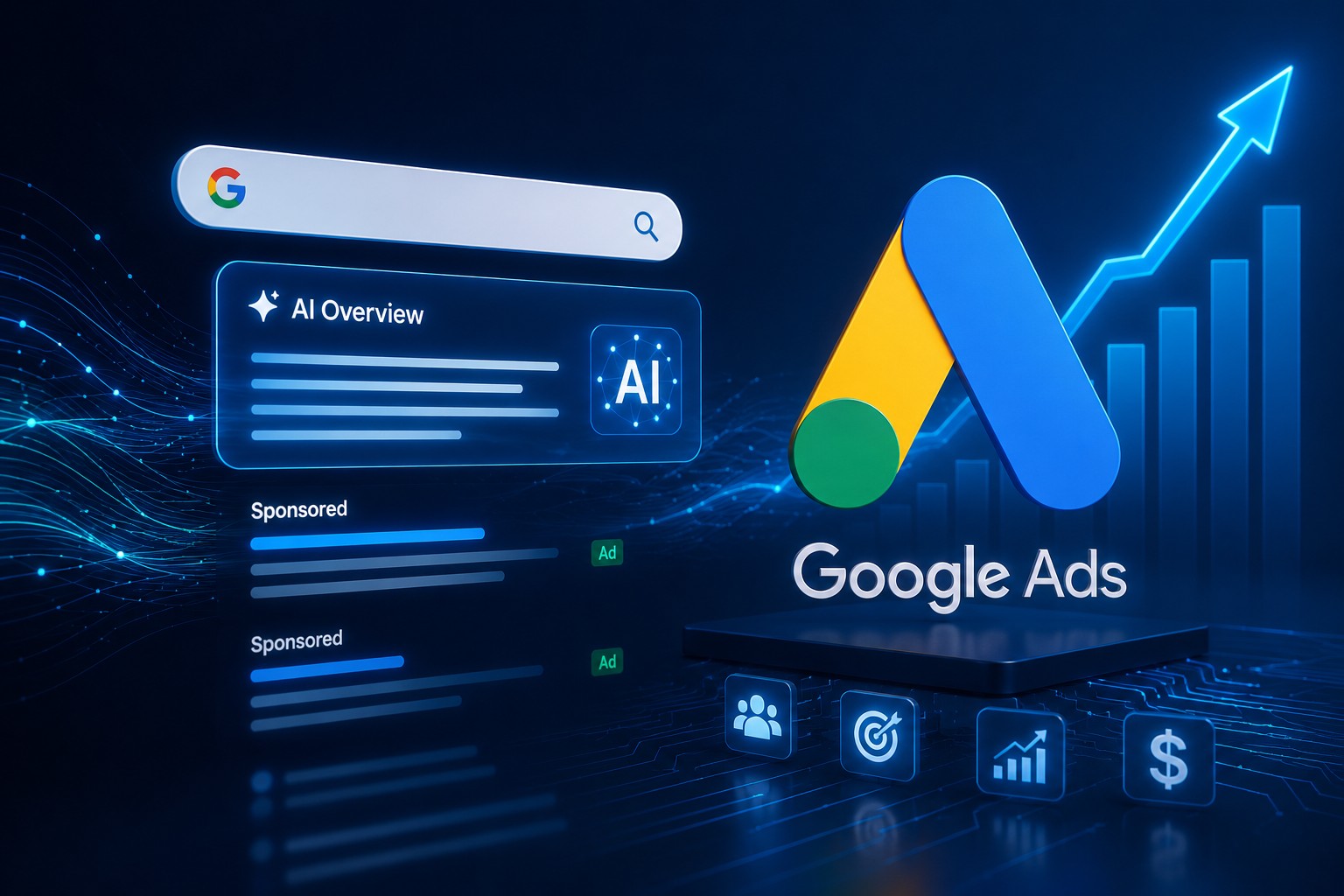
Google’s AI Overviews can appear at the top of the results page, with ads eligible to appear above, below, or within the AI-generated experience. Google says existing Search, Shopping, and Performance Max campaigns can participate automatically.
That creates a new environment for advertisers:
The customer may receive substantial information before they ever see—or click—the traditional search results.
And that changes the value of simply being the number-one paid result.
AI is changing what people search for
The bigger issue isn’t where an advertisement appears.
It’s what people type into Google in the first place.
Traditional search often looks like:
“best commercial HVAC company Denver”
AI-powered search can look more like:
“I own a 20-year-old commercial building in Denver and need to replace an inefficient HVAC system. What type of system should I consider, what will it cost, and what should I look for in a contractor?”
Those are radically different searches.
The second query contains considerably more context, intent, and nuance.
And Google is increasingly designed to understand that kind of query.
Google itself says AI Overviews are particularly useful for complex queries and questions where there may not be one obvious answer. Google also says its systems can use both the user’s query and the content of the AI Overview when determining which ads are relevant.
That means advertisers need to think beyond individual keywords.
The future of Google Ads is increasingly about understanding intent, context, and the entire customer journey.
Keywords are becoming less important
This doesn’t mean keywords are dead.
It means they are no longer the entire strategy.
Google is already moving advertisers toward AI-powered targeting. Google recommends broad match and keywordless technologies such as AI Max for Search campaigns to help advertisers reach the broader range of queries generated by modern search behavior.
Google is also transitioning Dynamic Search Ads into AI Max. The company says the transition to automatic upgrades will begin in February 2027.
The direction is clear:
Google wants its AI to do more of the work of determining which searches, users, ads, creative, and landing pages belong together.
For advertisers, this creates both an opportunity and a risk.
The opportunity is greater reach.
The risk is giving Google’s automation control over your advertising without giving it enough high-quality information about your business.
Your website is becoming part of your advertising strategy
This is one of the most important consequences of AI search.
In traditional PPC, advertisers could sometimes get away with mediocre website content.
You could build a highly targeted campaign, write a compelling ad, send visitors to a landing page, and optimize primarily around conversion rates.
AI search makes the website itself increasingly important.
Google’s AI systems need to understand what your company does, what products or services you offer, who they are for, how they differ from competitors, and why a customer should choose you.
That information isn’t contained exclusively in your ad.
It’s contained throughout your website.
Your service pages.
Your product pages.
Your FAQs.
Your case studies.
Your articles.
Your reviews and reputation.
Your structured data.
Your overall topical authority.
In other words:
SEO and PPC are becoming less separate.
The same information architecture and high-quality content that helps Google understand your business organically can also contribute to Google’s ability to understand the relevance of your advertising.
AI Search creates new advertising opportunities
This isn’t necessarily bad news for advertisers.
In fact, Google is actively building advertising into its AI search experience.
Google says ads can appear within AI Overviews when commercial intent is detected and the system can find relevant advertising. It also says ads may be matched based on both the user’s query and the content of the AI Overview.
Google is going even further with AI Mode.
In 2026, Google announced new ad formats for AI Mode designed around conversational and AI-generated search experiences. Google describes these formats as helping move consumers from discovery to decisions, with ads integrated directly into AI-generated responses while remaining clearly labeled as advertising.
This could create a completely different advertising environment.
Instead of:
Search → Ad → Website
the customer journey could become:
Question → AI conversation → Recommendation → Advertisement → Decision
That’s a much more sophisticated advertising model.
But there is a major problem for advertisers
AI can also reduce the number of clicks people make.
If Google answers more questions directly on the search results page, users may not need to visit as many websites.
That creates a paradox.
Businesses may have a harder time generating organic clicks while simultaneously becoming more dependent on paid advertising to reach customers who are still searching on Google.
Recent changes to Google Search are already pushing traditional results farther down the page. Google has begun automatically expanding some AI Overviews, placing the AI-generated response and follow-up interaction ahead of traditional results.
The result is a search page where the competition for attention is increasingly happening inside an AI-generated environment.
Advertisers cannot assume that the old search-results layout will remain the dominant advertising environment.
Google Ads and AI SEO are becoming connected
This is where forward-thinking businesses should pay attention.
AI SEO isn’t simply about getting a website to rank higher on Google.
It is increasingly about making a company understandable to AI-powered search engines.
That means clearly communicating:
- What the company does
- What products and services it provides
- Which problems it solves
- Who its ideal customers are
- Where it operates
- Why it is different
- What expertise it has
- What evidence supports its claims
- Which questions customers ask
- How its products and services compare with alternatives
That same information can potentially strengthen the ecosystem surrounding your paid advertising.
The result is a convergence of disciplines that historically operated separately:
SEO + Content + Website Strategy + Google Ads + AI Search Optimization
Businesses that continue treating each of these as completely independent channels may increasingly find themselves at a disadvantage.
The Google Ads agency model is changing too
This shift has implications for agencies.
For years, a Google Ads specialist could focus heavily on:
- Keyword research
- Match types
- Bid management
- Negative keywords
- Ad copy
- Quality Score
- Conversion tracking
- Cost per click
- Cost per acquisition
Those things still matter.
But they aren’t enough.
The next generation of PPC management requires understanding how AI interprets search intent and how a company’s entire digital presence supports that intent.
A good Google Ads strategy increasingly needs to ask:
What questions are potential customers asking?
What does Google understand about those questions?
What information does Google’s AI see when evaluating our business?
Does our website provide enough context for AI systems to understand our expertise and offerings?
Are our ads aligned with the actual customer journey?
Are we optimizing only for clicks—or for becoming the answer?
Those are fundamentally different questions from traditional PPC management.
AI could make Google Ads more competitive
There is another issue businesses need to consider.
As Google’s AI becomes better at understanding broad and conversational searches, advertisers may be competing for opportunities they weren’t explicitly targeting before.
Google’s AI Max technology is designed to expand Search campaigns into additional relevant opportunities. Google reported that advertisers using the full AI Max feature suite saw an average 7% increase in conversions or conversion value at a similar CPA/ROAS compared with search-term matching alone, according to Google’s internal data.
More opportunities can mean more customers.
But it can also mean more competition.
And potentially more money flowing into automated bidding systems.
That makes strategic oversight even more important.
Don’t abandon Google Ads. Adapt it.
The answer isn’t to stop advertising on Google.
Google remains enormously important.
Instead, advertisers need to recognize that Google Ads itself is becoming an AI-driven system.
The companies that benefit most may be those that give Google’s AI better inputs:
- Better website content
- Better conversion data
- Better product information
- Better landing pages
- Better creative
- Better audience signals
- Better first-party data
- Better understanding of customer intent
And this is where AI SEO becomes particularly important.
Your website shouldn’t simply be optimized to rank for a list of keywords.
It should be structured so that both people and AI systems can understand your business.
The biggest mistake advertisers can make
The biggest mistake is assuming that AI search is an SEO problem.
It isn’t.
It is a search problem.
And search affects both organic and paid traffic.
If customers change how they search, Google changes how it delivers results.
If Google changes how it delivers results, Google changes how advertisements are displayed and matched.
And if Google changes advertising, businesses have to change their PPC strategy.
That’s exactly what is happening now.
Google is already integrating AI into its search experience, introducing ads into AI Overviews, testing new advertising formats in AI Mode, and expanding AI-powered campaign technologies.
This isn’t some distant future scenario.
It is happening now.
The future of Google Ads is not just about buying keywords
For the last two decades, Google Ads rewarded businesses for understanding search behavior and buying the right keywords.
The next phase will reward businesses that understand intent.
The question won’t simply be:
“What keyword should I bid on?”
It will increasingly be:
“How does Google understand the customer’s question, and how does my business become the most relevant answer?”
That is a much bigger strategic challenge.
And it creates an enormous opportunity for businesses willing to rethink the relationship between their website, SEO, AI search, and paid advertising.
Google Ads isn’t going away.
But the Google Ads that businesses are running today may look very different from the Google Ads they are running two or three years from now.
The companies that start adapting now will have a significant advantage over those waiting for the old search model to return.
It isn’t coming back.
Frequently Asked Questions
AI is transforming Google Search from a simple list of links into an interactive, AI-powered experience that can interpret complex queries, generate answers, and summarize information. This shift means ads may appear within AI-generated responses, changing how and when users see advertisements and impacting the traditional pay-per-click model.
AI-powered search encourages users to enter more detailed, context-rich queries rather than simple keyword phrases. For example, instead of searching 'best HVAC company Denver,' a user might ask a complex question about their specific needs. This requires advertisers to focus on intent and context rather than just keywords.
Keywords remain relevant but are no longer the sole focus of advertising strategies. Google is promoting AI-powered targeting methods like broad match and AI Max for Search campaigns, which help advertisers reach a wider range of queries by understanding intent and context beyond individual keywords.
With AI search, Google's systems rely heavily on understanding a business through its website content, including service pages, FAQs, case studies, and reviews. High-quality, comprehensive content helps AI better interpret what a company offers, making SEO and PPC strategies more interconnected than before.
AI Search introduces new ad formats integrated directly into AI-generated responses, such as those in Google's AI Mode. These formats facilitate a conversational customer journey from discovery to decision, allowing ads to appear within AI Overviews and making advertising more interactive and contextually relevant.
As AI provides direct answers on the search results page, users may not need to click through to websites as often. This reduces organic traffic but increases dependence on paid ads to reach customers who still engage with Google, creating a paradox for advertisers.
The rise of AI search is blending SEO, content strategy, website optimization, and Google Ads into a unified approach. Businesses must clearly communicate their offerings and expertise across all channels to be understood by AI, or risk falling behind competitors who integrate these disciplines effectively.
Advertisers should focus on understanding customer intent, providing high-quality website content, and leveraging AI-powered targeting tools like broad match and AI Max. They must also prepare for new ad formats within AI-generated search experiences and ensure their business information is clear and comprehensive.
AI Max is Google's AI-powered targeting technology that helps advertisers reach a broader range of search queries by automatically matching ads to relevant searches without relying solely on keywords. It represents a shift toward automation and intent-based advertising, with Dynamic Search Ads transitioning into AI Max by 2027.
The AI-driven changes in Google Search require agencies to evolve their approach, integrating SEO, content, and AI optimization with traditional advertising strategies. Agencies must help clients adapt to new ad formats, AI targeting, and the importance of comprehensive website content to remain competitive.